
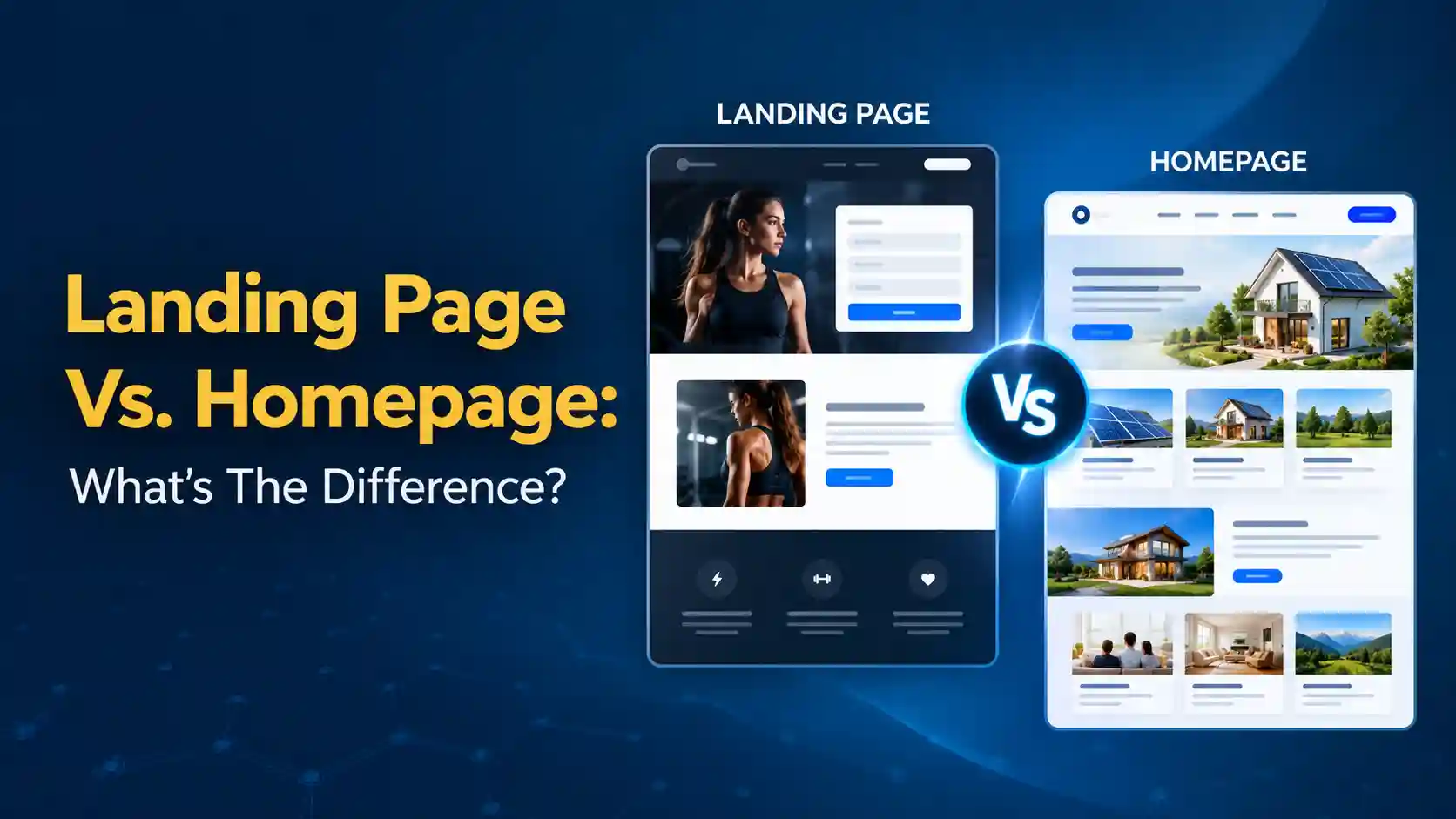
A landing page is a single, focused page built to get one action from one audience, such as a form fill or call booking. A website is a multi-page home for your brand, services, and trust content. Most businesses need a website first, then add WordPress landing pages for specific ad or email campaigns.
If you are weighing a WordPress landing page vs website, you are probably trying to avoid two expensive mistakes: paying for a full site you do not need yet, or sending ad money to a page that cannot answer a buyer’s questions.
The honest answer depends on your traffic source, your offer, and how much a buyer needs to know before they act. This guide walks through the difference, when each one wins, how Elementor fits in, what to watch for with SEO, and how to decide.
What is the difference between a landing page and a website?
A landing page is one page with one job. A website is a connected set of pages that helps people understand who you are and what you offer. Both can live on WordPress, and both can be built with Elementor.
| Factor | Landing page | Website |
|---|---|---|
| Goal | One action: form, call, demo, download | Many goals: inform, build trust, sell, support |
| Pages | One, sometimes with a thank-you page | Several to hundreds |
| Navigation | Minimal or none, to keep focus | Full menu, footer, internal links |
| Traffic source | Usually paid ads, email, social, QR codes | Search, direct, referrals, social, plus campaign traffic |
| Content depth | Short and persuasive | Deeper, with room for detail and proof |
| SEO role | Usually limited | Core long-term asset |
| Lifespan | Often tied to a campaign or offer | Ongoing |
| Best measured by | Conversion rate and cost per lead | Traffic, engagement, leads, and brand trust over time |
The real difference is intent. A landing page assumes the visitor already knows what they want. A website assumes they are still deciding whether to trust you.
When should you use a WordPress landing page?
A landing page fits when the visitor arrives with a specific reason, and you want one clear next step. Common cases:
- A paid ad campaign for one service or product
- A webinar, event, or demo registration
- A downloadable guide or checklist in exchange for an email
- A seasonal offer or product launch
- A local or industry-specific campaign that needs its own message
- A quick test of a new offer before investing in a larger site
The advantage is focus. Fewer links mean fewer exits, and a single message makes it easier to see what is working.
When do you need a full website?
You need a website when buyers have questions a single page cannot answer. That is common in B2B, where people compare providers, check credentials, and look for proof before they get in touch.
A website makes sense when you:
- Offer several services or products
- Want to rank in search for multiple topics over time
- Need pages for About, Services, case work, FAQs, and contact details
- Publish a blog or resource library
- Need a credible home for your brand that ads, email, and referrals can point back to
A landing page cannot do that job. A visitor who clicks “Who are you?” and finds nothing will usually leave.
Can you use both?
Usually, yes. For most growing businesses, the better question is not “which one?” but “which one first?” A practical order looks like this:
- Build the core website so you have a credible home base and a foundation for search.
- Add landing pages for individual campaigns, each with one offer and one audience.
- Link the pieces so a visitor who wants more detail can reach the main site, and the main site can feed campaign pages where it makes sense.
If budget forces a choice, a landing page can be a sensible starting point for a single, well-defined offer. Just treat it as a first step, not a replacement for a real site. You can see the kinds of projects Logic Labs Agency works on in our portfolio.
How do you build a landing page with WordPress and Elementor?
Elementor is a popular visual page builder for WordPress, and it can handle both landing pages and full sites. A few practical points:
- Build native pages. Elementor’s standalone “Landing Pages” feature has been deprecated in newer versions of Elementor Pro. Instead, construct a standard page using Elementor templates or canvas layouts to ensure compatibility and full feature support.
- Strip the page down. Use a minimal header, remove the main menu, and keep one primary button repeated at sensible points.
- Lead with the offer. Headline, short supporting copy, proof, and a form should all point to the same action.
- Plan your integrations. Ensure your current Elementor plan includes the advanced form widget and native CRM/email marketing connectors before finalising your layouts.
- Keep it fast. Heavy sliders, video backgrounds, and stacked animations slow pages down. Google recommends maintaining good Core Web Vitals: loading within 2.5 seconds, responding to input in under 200 milliseconds, and low layout shift. See Google’s Core Web Vitals documentation for technical benchmarks.
- Set up tracking before launch. Add analytics, conversion events, and a thank-you page so you can tell which ads produce leads.
- Test on mobile first. Many campaign clicks come from phones.
If you want a landing page that fits into a wider site plan, our website services page explains how we approach WordPress projects.
How do cost and timeline compare?
Exact prices vary too much by scope to quote honestly here, so use these drivers instead:
| Cost driver | Landing page | Website |
|---|---|---|
| Design and build effort | Lower, one focused layout | Higher, multiple templates and pages |
| Copywriting | Short, but must be sharp | Larger volume across many pages |
| Integrations | Form, CRM, analytics, ad pixels | Same, plus CMS structure, SEO setup, possible store or booking tools |
| Testing | Message and layout tests are common | Broader QA across pages and devices |
| Ongoing work | Updates per campaign | Maintenance, content, and SEO over time |
| Timeline | Highly accelerated turnaround | Comprehensive multi-week timeline |
How do you think about ROI?
A landing page is easiest to judge: compare ad spend and build cost with the leads or sales it produces. A website pays back more slowly through search visibility, trust, and repeat use.
Do not judge a website by the same short window you use for a campaign page, and do not expect a landing page to build long-term organic traffic.
What about SEO: landing page vs website?
A single, thin landing page rarely competes for broad search terms. A website with useful, well-structured pages has far more room to rank. Two cautions:
- Avoid doorway pages. Google’s spam policies describe doorway abuse as creating pages to rank for specific, similar queries. Cloning near-identical landing pages for every keyword or city variation is a major risk. Read the policy in Google’s spam policies for web search.
- Decide whether the page should be indexed. Pages built exclusively for paid traffic should explicitly be set to
noindexso they do not conflict with or dilute the authority of your core organic landing pages. Pages meant to rank should be unique, contextually linked, and genuinely useful.
What mistakes do businesses make with landing pages and websites?
- Sending broad traffic to a narrow page, or narrow traffic to a broad homepage.
- Using a landing page as the whole business presence with no About page, proof, or contact details.
- Adding too many goals to one landing page. Three offers mean no clear offer.
- Ignoring speed. Page builders are flexible, but unmanaged widgets and large images add weight.
- Skipping tracking. Without conversion events, you cannot learn from the campaign.
- Mass-producing near-duplicate pages for SEO.
- Forgetting maintenance. Plugins, themes, and Elementor updates still need care after launch.
Which one should you choose? A quick checklist
Answer these five questions:
- Do you already have a credible website? If not, start there.
- Are you running a specific campaign with one offer? A landing page fits.
- Do buyers usually need to research you before they call? You need site pages that answer their questions.
- Do you want search traffic over time? Build content on a full website.
- Can you measure results? If yes, landing pages are easy to test and improve.
Conclusion: start with the job, not the format
A WordPress landing page converts a specific visitor to a specific action. A website earns trust, supports search, and gives every campaign a place to point. Most businesses end up needing both, and the order depends on budget and goals.
If you are not sure where to start, talk it through with someone who builds on WordPress daily. You can contact Logic Labs Agency, and we will help you work out a sensible scope for your situation.
FAQs
Is a landing page better than a website?
Neither is better in general. A landing page is better for one campaign with one offer. A website is better for building trust, covering several services, and earning search traffic.
Can I use a landing page instead of a website?
For a short-term offer or early test, yes. For a lasting business presence, no. Buyers who want to check who you are need more than one page.
Can WordPress do both landing pages and websites?
Yes. WordPress can run a full site and individual campaign pages, and builders like Elementor can design both.
Do I need Elementor to build a landing page on WordPress?
No. You can use the block editor or another builder. Elementor is popular because of its visual editing and templates, but your choice should align with the form functionality and integrations required by your marketing stack.
Do landing pages help SEO?
Sometimes, but they usually carry less SEO weight than a content-rich website. Avoid near-duplicate pages made only to capture search variations.
How long does it take to build a landing page compared with a website?
A landing page is significantly faster because it is a single focused layout, while a full website requires complex content architectures, design assets, and extensive user-journey testing. Content readiness and approvals usually decide the real timeline.
Should my landing page have a navigation menu?
Usually not. A minimal header keeps attention on the main action. Keep a subtle way to reach your main site if buyers may want more proof.
What should I build first if my budget is limited?
If you have no site at all, start with a small but credible website, then add landing pages. If you already have a site and want to test an offer, a landing page is a sensible first step.
Ready to talk about your project?
If you would like a clear view of what your business needs, the Logic Labs Agency team is happy to talk it through. Share your goals and your main concerns, and we will suggest a sensible scope.
- Phone: +1 972-338-4933
- Email: info@logiclabsagency.com
- Address: Dallas, TX, United States